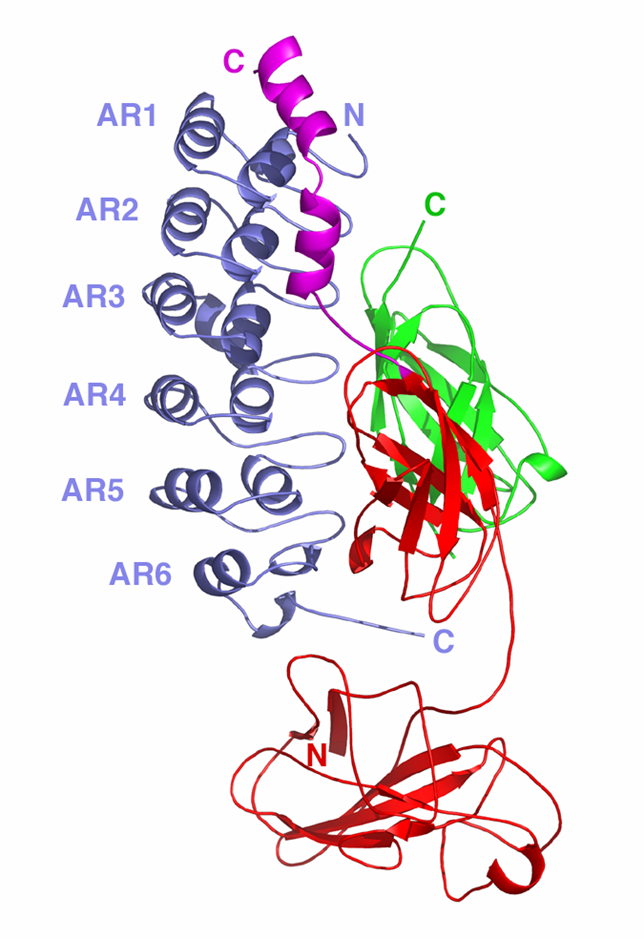
The nuclear factor kappa B (NF-kB) is a family of transcription factors that control inter- and intracellular signaling, cellular stress responses, cell growth, survival, and apoptosis (Baldwin 1996; Ghosh et al. 1998; Gerondakis et al. 1999). Indeed, some 58 viral or bacterial products, some 46 stress conditions and chemicals, and some 32 cytokines and receptor ligands, as well as apoptotic mediators and mitogens, activate the NF-kB signaling system and subsequently more than 150 target genes (Pahl 1999). In resting cells, NF-kB dimers with transcription activation potential are sequestered in the cytoplasm by interaction with a family of inhibitors of kappa B proteins (IkBs) (Karin and Ben-Neriah 2000). Following the action of a large number of different stimuli, the inhibitor is phosphorylated, ubiquinated, and degraded, freeing the NF-kB nuclear localization signal (NLS) which targets the NF-kB to the nucleus. This simple model, however, does not account for many experimental results. For instance, knock-out experiments show that there are subtle overlaps and yet specificity in the interactions among different inhibitors and different forms of NF-kB (Hoffmann et al. 2002). Hoffmann has shown that differential transcription activation of target genes is linked to temporal control of NF-kB activity (Hoffmann et al. 2002). From his mathematical model of signaling, he can predict which parameters (binding rates, intracellular concentrations, fluxes) are “sensitive” to small changes in magnitude (Quiambao et al., in preparation). One of the sensitive parameters seems to be the intracellular half-life of IkBa, which is the only essential inhibitor family member (Klement et al. 1996; Hoffmann et al. 2002). A second level of control may involve newly synthesized free IkBa, which, though short-lived, may promote dissociation of NF-kB from transcription sites. A mechanistic understanding of these protein-protein interactions will perhaps lead to better modulators of chronic inflammation and chemotherapeutic agents (Tak and Firestein 2001; Yamamoto and Gaynor 2001).
In Overall AIM 1, we will explore the dynamics of the interaction between the NF-kB transcription factors and their inhibitors. Komives (Project 1) will measure the binding kinetics and thermodynamics for the IkBa/NF-kB interaction and will “take-apart” the NF-kB to quantify the contributions made by the various domains of NF-kB to IkBa binding. Ghosh (Project 2) will solve structures of complexes between other NF-kB and IkB family members in an effort to understand the specificity of the interaction. Wolynes (Project 3) will make theoretical predictions of whether and where folding is coupled to binding in the interaction. Dyson (Project 4) will monitor structural and dynamics changes that occur upon complex formation. Hoffmann (Project 5) will refine his mathematical model of the signaling pathway based on kinetic and thermodynamic data to explore the importance of IkBa/NF-kB interactions in gene regulation (Hoffmann et al. 2002).
In Overall AIM 2, we will explore the structure and function of free IkBa and endeavor to understand whether its partially folded structure is important for any of its functions. Wolynes (Project 3) will predict the folding energy landscape of IkBa, and identify the folding routes and the critical residues involved in the folding transitions. Komives (Project 1) will make mutations at the critical residues identified by Wolynes to understand how the sequence determines the in vitro thermodynamic stability of free IkBa and the binding kinetics and thermodynamics. Ghosh (Project 2) will measure susceptibility of these variants of free IkBa towards proteosomal degradation in vitro. Dyson (Project 4) will use NMR to determine the structure and backbone dynamics of free IkBa and of some mutants with altered stabilities. Hoffmann (Project 5) will measure intracellular degradation rates of these same mutants. Although several groups have hypothesized a link between ubiquitin-independent proteasome degradation and a “loosely-folded” structure, no systematic study of this link has, to our knowledge, been attempted. In Overall AIM 3, we will develop novel integrative approaches that cross the boundaries from in silico theory to in vitro biochemical and biophysical experiments to the in vivo properties of the NF-kB signaling network. Wolynes and Dyson will develop theoretical algorithms to more accurately predict structures from low resolution experimental data on partially folded protein ensembles. Komives, Dyson, Ghosh, and Hoffmann will all use the same panel of mutants, predicted by Wolynes to have varied in vitro thermodynamic stabilities, to attempt to cross over the boundary between in vitro measurements and in vivo measurements. The development of these seamlessly integrated approaches will provide a model for how to proceed to analyze other more complicated protein-protein interaction networks. Thus, the NF-kB/IkB signaling system represents a unique example where a deep biophysical understanding of the protein interaction dynamics can be quantitatively linked to the emergent biological response. |